

Salesforce
Salesforce is an AI powered CRM platform that unifies sales, service, marketing, and customer data for teams that need scale, automation, and visibility.
About Salesforce
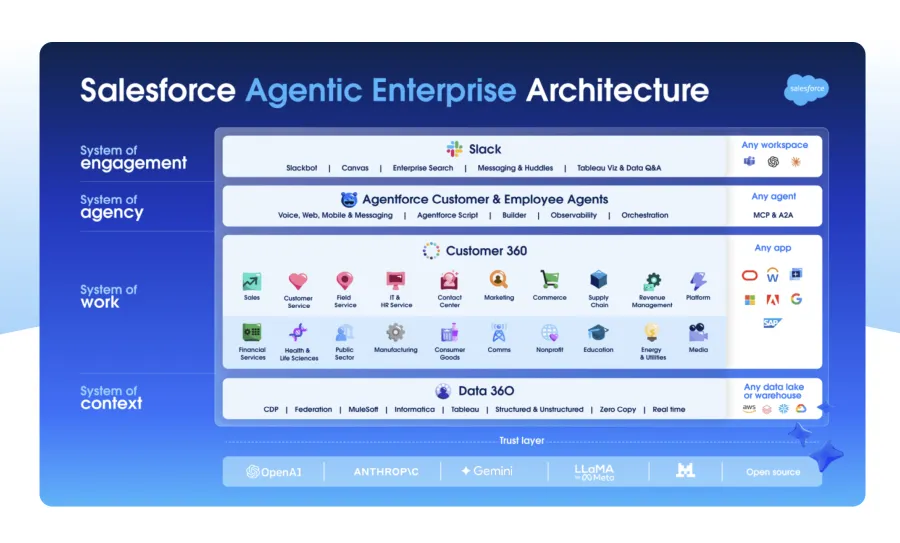
Salesforce is a cloud based AI CRM platform built to help businesses manage customer relationships, revenue workflows, service operations, and connected business processes on one unified system. Its platform brings together customer data, AI, automation, analytics, and business applications so teams across sales, service, marketing, commerce, and IT can work from a shared view of the customer.
Rather than operating as a single purpose sales tool, Salesforce has evolved into a broad enterprise platform designed for scale, customization, and cross functional collaboration. With products such as Customer 360, Sales Cloud, Data Cloud, Agentforce, and Slack, Salesforce is positioned for organizations that want a connected system for customer engagement, internal productivity, and AI powered operations.
Key Features
- Unified CRM: Manage sales, service, marketing, and commerce workflows on one platform.
- Lead Management: Capture, track, and prioritize leads with AI assisted workflows.
- Pipeline Visibility: Monitor opportunities, deal progress, and pipeline trends in a consolidated view.
- Activity Capture: Automatically capture emails, events, and engagement activity inside CRM.
- Reports and Dashboards: Use built in reporting and dashboards to track sales performance and pipeline metrics.
- Extensible Ecosystem: Extend Salesforce with AppExchange apps, MuleSoft integrations, Slack, and learning resources through Trailhead.
Pricing
-
Free Suite: $0/user/month Entry level CRM access for small teams with a free starting point.
-
Starter Suite: $25/user/month Includes marketing, sales, service, and commerce tools in a single CRM suite.
-
Pro Suite: $100/user/month Expands Starter Suite with more features for customization, automation, and broader CRM workflows.
-
Enterprise: $175/user/month Adds advanced capabilities for larger sales organizations.
-
Unlimited: $350/user/month Higher tier edition with expanded enterprise functionality and bundled Premier Success Plan benefits on applicable Salesforce plans.
-
Agentforce 1 Sales: $550/user/month Premium sales edition listed on Salesforce Sales Pricing.
Pricing last updated: April 19, 2026 at 12:00 AM
Use Cases
- Manage sales pipelines and opportunities across growing revenue teams
- Centralize customer records, activities, and account history in one CRM
- Support marketing, service, and commerce workflows on a shared platform
- Build customized CRM processes for mid market and enterprise organizations
Pros & Cons
Pros:
-
Broad CRM platform covering sales, service, marketing, and commerce
-
Strong native reporting, pipeline management, and lead management features
-
Large ecosystem with integrations, partner apps, and training resources
Cons:
- Pricing and product structure can become complex as teams scale
- Full platform breadth may be more than smaller teams need at the beginning
Integrations
Slack, Tableau, MuleSoft, AppExchange
FAQ
Tags:
Last edited
April 19, 2026 at 8:34 AM by Venkatraman C
Salesforce Buyers Guide
- Why Salesforce?
- In-depth analysis of Salesforce
- 1. Salesforce is now positioned as a platform, not just a CRM
- 2. Its strongest practical value is operational centralization
- 3. Salesforce is strongest for organizations that need scale and depth
- 4. AI is now central to the Salesforce story
- 5. The ecosystem is part of the product advantage
- 6. The tradeoff is complexity
Why Salesforce?
For many buyers, Salesforce is less a single tool and more a software ecosystem. Its value comes from combining apps, automation, reporting, integrations, and AI on one platform rather than solving only one narrow use case. That broad positioning is why Salesforce usually fits best under CRM Software at the category level, even though its capabilities stretch into sales automation, customer service, analytics, integration, and internal collaboration.
In-depth analysis of Salesforce
1. Salesforce is now positioned as a platform, not just a CRM
A common mistake is to think of Salesforce as only a sales tool. The company’s current positioning is much wider. Salesforce describes itself as an AI CRM and frames Customer 360 as a connected layer of AI powered apps across sales, service, marketing, commerce, IT, and industry solutions. That means the product should be understood as an enterprise customer platform rather than a simple lead or pipeline manager.
This platform approach matters because software buyers increasingly want fewer disconnected tools. Salesforce’s proposition is that customer data, workflows, reporting, and AI should sit in one trusted system. For organizations with multiple teams touching the customer journey, that can be a major strength.
2. Its strongest practical value is operational centralization
Salesforce’s core business value is centralization. Sales Cloud, for example, brings lead management, account management, opportunity tracking, activity capture, reporting, and automation into one environment. This gives teams a more structured way to manage handoffs, pipeline visibility, and seller productivity.
That centralization also extends beyond sales. Customer 360 is designed around a shared customer view across departments. In practical terms, this means service, marketing, and sales teams can work from connected records and workflows instead of fragmented tools and duplicated information.
3. Salesforce is strongest for organizations that need scale and depth
Salesforce is especially well suited to businesses that expect process complexity, multiple teams, layered permissions, advanced reporting, and long term extensibility. The platform’s packaging ranges from entry level suites to enterprise and unlimited plans, which shows that Salesforce is designed to serve both smaller and larger organizations, but its real strength tends to emerge as operational needs become more complex.
For smaller teams, Salesforce can still be used through Free Suite or Starter Suite. But the broader brand promise is clearly built around scale, integrated operations, and configurable enterprise workflows rather than minimal simplicity.
4. AI is now central to the Salesforce story
Salesforce’s current messaging strongly emphasizes AI, agents, and unified data. Its homepage, investor materials, and product portfolio all point to the same direction: Salesforce wants to be the operating layer where humans and AI agents work together inside business workflows. Agentforce, Data Cloud, and Customer 360 are presented as connected pillars in that strategy.
This is important from a content perspective too. When you feature Salesforce on VenkatSoftware.com, the write-up should not sound like a traditional CRM article from five years ago. The official positioning now is AI CRM plus unified data plus workflow execution across the business.
5. The ecosystem is part of the product advantage
One of Salesforce’s biggest structural strengths is its ecosystem. Slack, Tableau, MuleSoft, AppExchange, and Trailhead all reinforce the value of the core platform. This makes Salesforce attractive to buyers who need more than an app and instead want a long term software foundation with integration, analytics, partner extensions, training resources, and internal collaboration layers.
For enterprise buyers, this ecosystem often matters as much as the CRM itself. It reduces the risk of choosing a tool that cannot expand with future data, reporting, or integration requirements. That is one reason Salesforce remains relevant across industries and large organizational environments.
6. The tradeoff is complexity
The same breadth that makes Salesforce powerful can also make it complex. Its product family, editions, and cloud specific offerings can be harder to understand than a focused point solution. Official pricing pages show multiple suite levels and premium editions, which is useful for segmentation but also signals that Salesforce is a layered product family rather than a straightforward one-size purchase.
That does not make it a weak product. It simply means Salesforce is often a better fit for buyers who value configurability, ecosystem depth, and cross functional operations more than simplicity alone.

Similar to Salesforce


