
 A Human Edited Software Directory
Uber CTO Praveen Neppalli Naga Shares How Agentic AI changing the way they build?
Published by Venkatraman Chandrasekaran |Agentic AI
Uber Chief Technology Officer Praveen Neppalli Naga has shared how the company is expanding agentic AI beyond software engineering and into business functions such as finance, legal, operations, marketing, customer support, HR, and procurement.
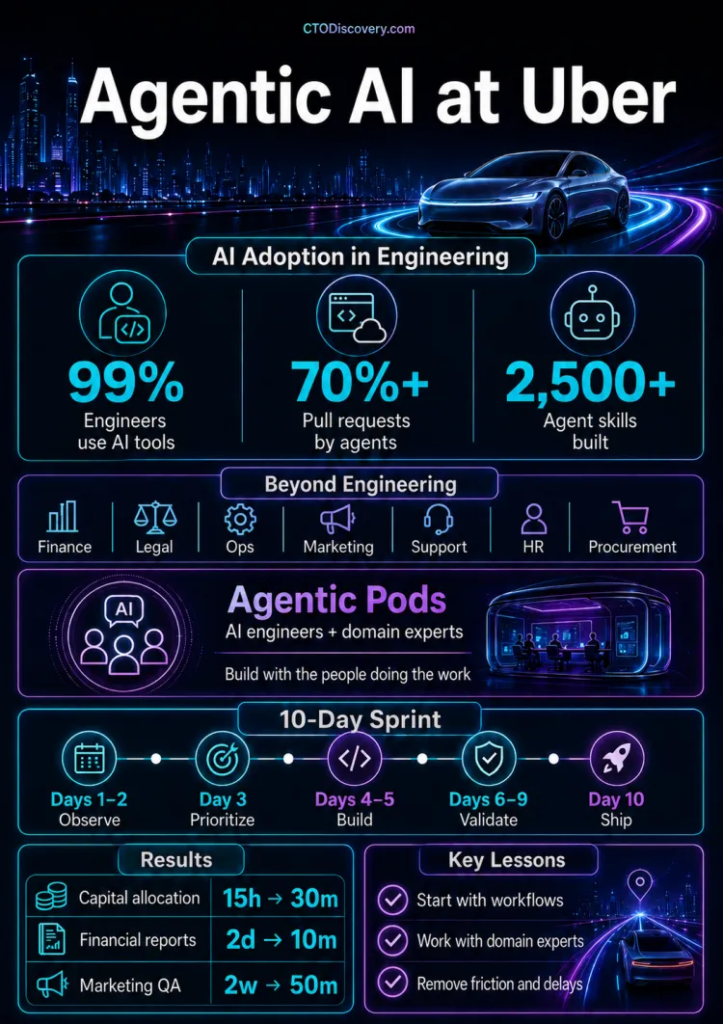
In his message, Naga said agentic AI adoption at Uber is already strong inside engineering. According to the post, 99% of Uber engineers use AI tools, more than 70% of pull requests are attributed to local or cloud agents, and Uber engineers have built more than 2,500 agent skills across the software development lifecycle.
But the more useful lesson for technology professionals is not only the adoption number. It is the operating model Uber used to find real AI opportunities inside business workflows.
Uber created what it calls “Agentic Pods.” Each pod paired an AI-proficient engineer with a domain expert from a business function. The teams were given two weeks to observe the real workflow, identify high-impact opportunities, build a working AI agent, validate it with users, and then ship it.
| What Uber’s message highlights | Why it is useful for tech professionals? |
|---|---|
| AI adoption started strongly inside engineering. | Engineering teams can become the testing ground for AI-native workflows before expanding AI across the company. |
| 99% of Uber engineers reportedly use AI tools. | AI adoption becomes meaningful when it becomes part of daily work, not just a pilot or innovation project. |
| More than 70% of pull requests are attributed to local or cloud agents. | AI is no longer only assisting developers; it is becoming part of the software delivery process. |
| Uber built 2,500+ agent skills across the software development lifecycle. | Scalable AI adoption requires reusable skills, not one-off experiments. |
| Uber moved agentic AI into finance, legal, operations, marketing, customer support, HR, and procurement. | The biggest AI opportunities may be outside engineering, especially in departments with repetitive and manual workflows. |
| Each Agentic Pod paired an engineer with a domain expert. | AI projects work better when builders sit with the people doing the work instead of automating from a distance. |
| Pods first shadowed the expert and studied the real workflow. | Documentation alone is not enough. Real process understanding comes from observing actual work. |
| Uber prioritized opportunities based on scale, repetition, business impact, and data availability. | Not every workflow deserves automation. Teams should choose problems where AI can create measurable value. |
| Pods built working agents quickly and validated them with multiple users. | Fast validation helps teams avoid building AI tools that work only for one person or one narrow case. |
| Uber reported major workflow improvements, including capital allocation moving from 15 hours to 30 minutes, financial pacing reports from 2 days to 10 minutes, and marketing web QA from 2 weeks to 50 minutes. | AI impact should be measured in workflow speed, decision quality, and business outcome, not only in model capability. |
| Uber’s key lesson was that the workflow is the unit of automation, not the individual task. | The real value of AI comes when teams redesign how work flows across people, tools, approvals, and systems. |
| Uber is now forming a dedicated team to scale the approach further. | Successful AI adoption needs an operating model, ownership, and repeatable execution—not isolated experiments. |
The broader takeaway for CTOs, engineering leaders, and AI transformation teams is clear: agentic AI should not be treated as a tool that simply speeds up existing tasks. The larger opportunity is to redesign complete workflows around AI.
Uber’s approach also shows why domain knowledge matters. Many AI projects fail because teams start with a model or a tool. Uber’s message suggests a different path: start with the people doing the work, understand where friction exists, and build AI systems with them.
For tech professionals, this is an important shift. The future of enterprise AI may not be about asking, “Which task can we automate?” It may be about asking, “Which workflow should be redesigned from the ground up?”
Source: Praveen Neppalli Naga’s post, also reposted by Uber Engineering; Uber official leadership profile.
Venkat