
 A Human Edited Software Directory
Google DeepMind Researchers Map Four Possible Paths From AGI to Superintelligence
Published by Venkatraman Chandrasekaran |Technology Research
Google DeepMind researchers have published a new paper that shifts the artificial intelligence debate beyond a familiar question: when will machines reach human-level general intelligence?
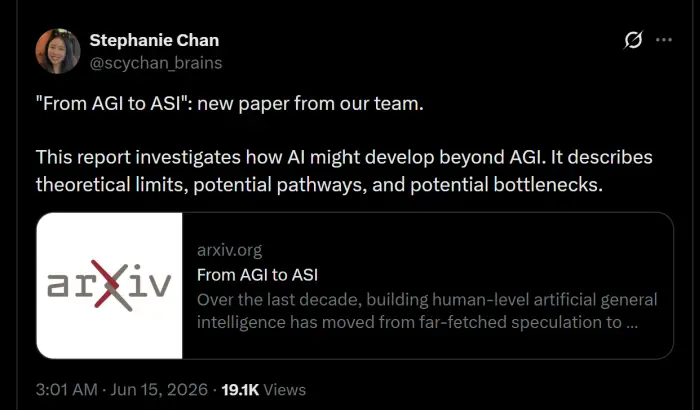
The paper, titled “From AGI to ASI,” examines what may happen after artificial general intelligence arrives. Instead of treating AGI as the endpoint of AI progress, the authors frame it as a possible starting point for a further transition toward artificial superintelligence, or ASI.
The report was authored by a large Google DeepMind research group including Tim Genewein, Matija Franklin, Alexander Lerchner, Laurent Orseau, Stephanie Chan, Iason Gabriel, Joel Z. Leibo, Allan Dafoe, Marcus Hutter, Thore Graepel, and Shane Legg.
AGI may not be the finish line
The paper defines AGI in practical terms as a system that reaches roughly median human-level ability across most cognitive tasks. That does not mean such a system would be merely human-like in every area. The authors note that current AI systems are already superhuman in several narrow domains, so a future AGI could have an uneven capability profile: human-level in general adaptability, but far beyond humans in selected tasks.
ASI is framed differently. It is not simply a chatbot that performs better than an individual expert. The report describes artificial superintelligence as a system, or collection of systems, that can outperform large organizations of human experts working over long periods of time.
That framing matters because it moves the conversation away from single-model benchmarks. The real question becomes whether AI systems can scale into digital organizations: faster, cheaper, more coordinated, and more capable than human institutions.
Four routes from AGI to ASI
The report outlines four broad pathways that could move AI from AGI to ASI.
The first path is scaling. This is the continuation of the current AI playbook: more compute, larger models, more data, better training methods, and greater use of test-time computation. The authors are careful not to claim that scaling alone will necessarily produce ASI, but they argue it remains one possible route.
The second path is an algorithmic paradigm shift. AI progress may not only come from making current architectures larger. New architectures, learning methods, memory systems, reasoning techniques, or world-modeling approaches could change the trajectory. This route is harder to forecast because major scientific and engineering breakthroughs rarely arrive on schedule.
The third path is recursive improvement. If AI systems become strong enough to contribute meaningfully to AI research, they could help design better models, write stronger training code, improve evaluation methods, discover new architectures, and speed up the next cycle of progress. In the strongest version of this scenario, AI systems begin improving the tools used to improve themselves.
The fourth path is multi-agent coordination. ASI may not emerge from one single model. It could emerge from many AI agents working together, dividing tasks, sharing context, specializing by function, and operating as a coordinated digital organization. This is especially relevant for enterprise AI because many companies are already experimenting with agentic systems, automated workflows, coding agents, research agents, and AI-operated business processes.
The enterprise AI stack may look less like a single chatbot and more like a managed network of digital workers.
The report points toward a future where capability is not only inside the model. Capability may also come from orchestration, memory, tools, compute allocation, simulation environments, and multi-agent workflows.
That has direct implications for software architecture. AI systems may need persistent memory, retrieval infrastructure, specialized agents, verification loops, sandboxed execution, human oversight, and better monitoring. The enterprise AI stack may look less like a single chatbot and more like a managed network of digital workers.
This is already visible in the market. AI coding tools are becoming more agentic. Workflow automation platforms are adding autonomous task execution. Cloud providers are positioning infrastructure for agent deployment. Developer tools are moving from “generate a response” toward “complete a task.”
The report is also cautious
Although the paper discusses superintelligence, it does not present ASI as automatic or unconstrained. It highlights bottlenecks that could slow or redirect progress.
Data scarcity could limit further training. Hardware and energy constraints could affect scaling. Current model architectures may hit performance ceilings. Some tasks may remain hard to improve through language-only systems. Human institutions may also impose regulation, compute controls, or safety-related limits.
This makes the paper more useful than a simple prediction. It is less a claim that ASI will arrive on a fixed date and more a research map for understanding how progress could continue after AGI.
A new research agenda
One of the most important signals from the paper is that AI research is entering a new phase. The industry is no longer only asking whether AGI is possible. Leading researchers are now asking how to measure post-AGI progress, how to understand multi-agent scaling, how to evaluate recursive improvement, and how to prepare institutions for systems that may improve science and technology faster than humans can alone.
For enterprise leaders, the lesson is clear: the next wave of AI strategy should not focus only on which model is best today. It should also focus on how AI systems are organized, governed, connected to tools, and scaled across teams.
AGI may become a milestone. But the larger transformation could come from what happens after it.
Sources
Primary source: From AGI to ASI,” arXiv:2606.12683
Additional source: Google DeepMind publications page
Related social source: Stephanie Chan post on X discussing the paper